About the collector • Leonard Krawchuk
By Dr. Natalie Kononenko (2025)
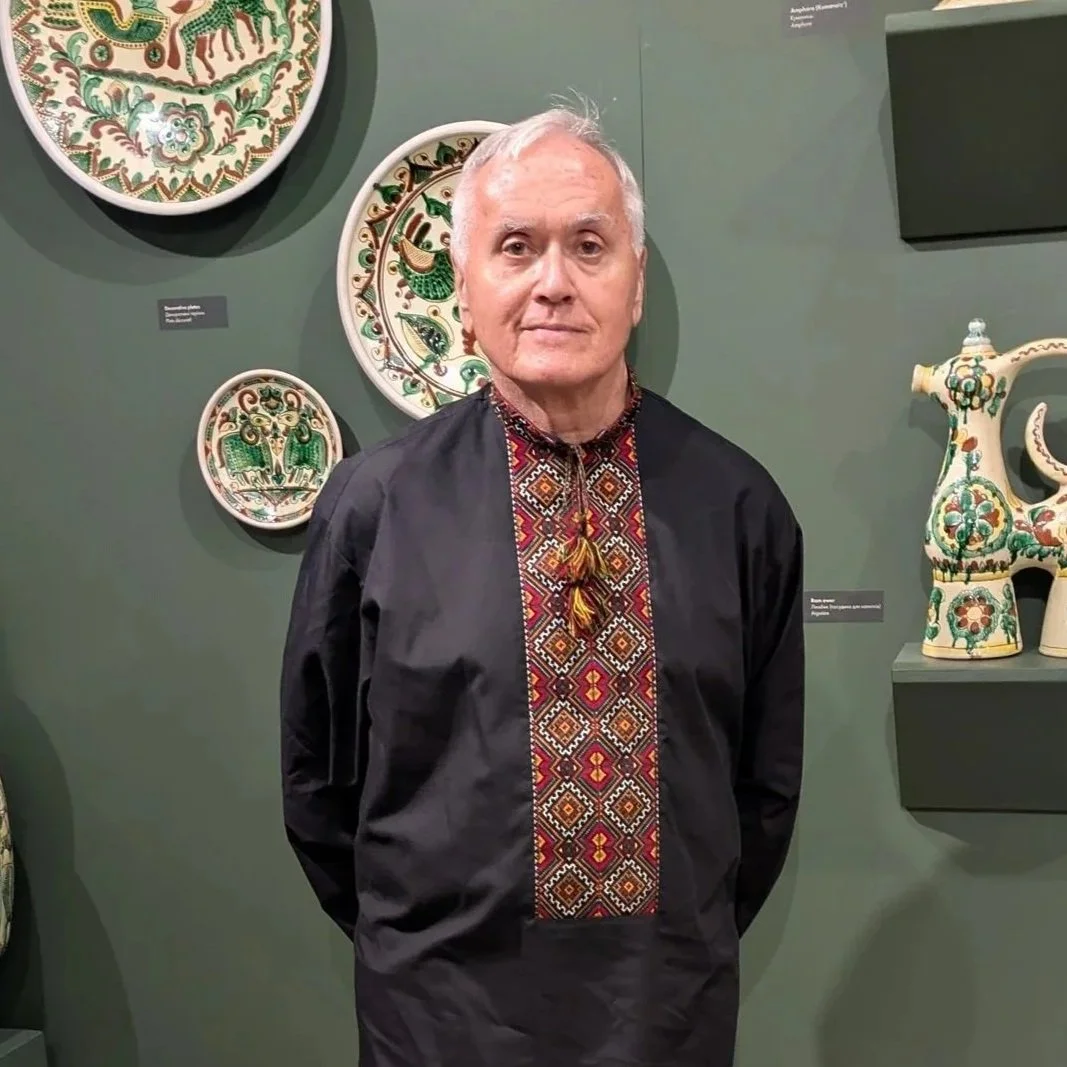
Leonard Krawchuk is one of the most prominent collectors of Ukrainian folk art in Canada. His ancestors had come from Ukraine in 1902. His father and uncle searched for employment opportunities, finally settling in Flin Flon, Manitoba, where Leonard was born in 1947. Leonard attended school in Flin Flon and also participated in the Ukrainian Catholic church, where he sang in the choir and served as an acolyte. Like many places with a Ukrainian population in Canada, Flin Flon had a Ukrainian dance program for children, and Leonard was an enthusiastic participant. His parents were wary of showcasing their Ukrainian heritage because, at that time, being a foreigner or even a person of non-Anglo heritage was difficult. It was Leonard’s aunt who filled Leonard in on his Ukrainian background.
Leonard’s enthusiasm for Ukrainian dance and other aspects of Ukrainian culture was evident and caught the attention of other Ukrainian enthusiasts. Soon, William Perepiluk, a local philanthropist, decided to pay for Leonard to attend classes at St. Andrews College in Winnipeg so he could bring his knowledge back to Flin Flon and teach the youth there. St. Andrews College had teachers from the newspaper Ukrainian Voice in Winnipeg and also from Ukrainian language schools across the province of Manitoba. The trip to Winnipeg was a revelation for Leonard. Winnipeg was, in many senses, a Ukrainian hub. In the early days of Ukrainian settlement in Canada, Winnipeg is where new arrivals came by train. From there, they then took land transportation to the various farming settlement locations on the Prairies. As a result, Winnipeg was the home of Ukrainian university programs and their libraries. Bookstores were located there, as well as labour support organizations, Ukrainian churches, and other cultural offices focused specifically on Ukraine and the many arrivals to Canada from that country.
In Winnipeg, Leonard discovered bookstores and museums, including the Ukrainian Museum of Canada, Manitoba Branch. He went to the University of Manitoba. He discovered libraries and collections of books that exceeded anything he could have imagined. He met Orysia Tracz, the librarian who, as a fellow Ukrainian enthusiast, became a lifelong friend.
Leonard returned to Flin Flon and went back to dance instruction there. He taught in the dance programs at both the Ukrainian Catholic and Ukrainian Orthodox churches and expanded his teaching to students at Le Pas. His students were most enthusiastic and appreciative of Leonard as an instructor. The three groups taught by Leonard entered dance competitions and did extremely well. They received widespread media coverage, much to their, and everyone else’s, delight. Leonard wanted to go back to St. Andrew’s to study further, and this trip was paid for by his students’ parents. The media attention Leonard had received, along with the success of his dance groups, caught the attention of Father Sawchuk in Winnipeg, and he asked Leonard to take over dance instruction in that city.
From this point on, Leonard stayed in Winnipeg. He taught dance. He worked with various Ukrainian organizations. To support himself, Leonard, always a person who liked working with people, took on jobs as a nurse at Misericordia and also in long-term care homes and other extended care facilities. Of course, his real passion was in his exploration of Ukrainiana. Leonard continued his work with libraries, bookstores, and the facilities of St. Andrew’s College. He acquired books of his own as often as he could. He became heavily involved in museums and other cultural institutions. Oseredok was particularly important, as was the Ukrainian Museum of Canada, both the Winnipeg branch and the one in Saskatoon. Through his activities, Leonard met and became friends with Robert Bohdan Klymasz, the most important early collector of Ukrainian folklore in Canada and often considered the father of Ukrainian Canadian fieldwork. He became friends with this author, and he corresponded and discussed folk art. He also became friends with Chester Kuc of Edmonton and Prof. George Kozholenko and his wife. Kozholenko was in Edmonton but had been a professor at the Chernivtsi Ukrainian Folk Culture program; his wife was the curator of the Ukrainian Catholic Museum in Saskatoon. They would visit Leonard whenever they were in Winnipeg and pass along books and Ukrainian folk items.
Leonard wanted to see not only books about Ukraine and folk heritage items brought to Canada from that country – he wanted to see Ukraine itself. His first opportunity came in 1975. Unfortunately, the way excursions for foreigners were arranged at that time meant that Leonard got to travel to major cities only and seeing the countryside where his family came from and getting to meet various craftspeople was not possible. On his second trip to Ukraine in 1986, Leonard was more adept at working around Soviet restrictions. He made it to Kosiv, which he very much wanted to visit, but not to the Kosiv bazar, which was famous for the folk art items that were sold on its premises. He did go to a 19th-century wooden church which, by then, had been turned into a museum, and met the potter Stefania Voloshchuk. He hired a driver, and this allowed him to go to the countryside and meet master craftsmen. He also got to see his great-grandfather’s village. This visit was quite a disappointment as little was left. Even the graveyard where one would suppose that grave markers would survive did not show what Leonard wanted to see. Leonard did meet craftspeople and was able to acquire some lovely pottery. Unfortunately, even this was subjected to Soviet destruction as the group leader of Leonard’s tour made sure that Leonard’s soft-sided luggage ended up at the bottom of the tour group’s luggage pile, and many pottery items were broken.
Leonard’s third trip was after 1997, when Ukraine had become independent. The trip was led by Orysia Tracz, who was taking multiple groups of Ukrainian heritage people from Canada and the United States to see their home country. Leonard got to see Pochaiv and one of the main monasteries in Ukraine outside of the Lavra in Kyiv. He also went to the village of Navashia, in Brody, another location associated with his ancestors. He was able to visit more places that he wanted to see and acquire more folk art objects. All in all, the places that he had visited on his three trips were Kyiv, Lviv, Ternopil, Chernivtsi, Kremenchuk, Vinnytsia, and Odesa. He even got to see a collective farm in the village of Malaga.
Leonard worked out a complex but effective system for having the objects that he wanted shipped to Canada. Some items were carried by people visiting Ukraine, this writer among them. Others were mailed. Some went to countries neighbouring Ukraine and were then shipped from there. Leonard’s many friends kept him informed of newly published books about Ukrainian folk art and helped him acquire these, along with the objects he wanted. Leonard collected ceramics, folk dress, both women’s and men’s. He collected paintings and samples of embroidery techniques and styles. He collected kilims, heavy, woven tapestries used both as wall-hangings and as blankets. All in all, he acquired a truly astounding collection, some of which you see here.
Leonard was also an artist himself, and not just a skilled dancer who taught and inspired others. Leonard painted, and his paintings attracted collectors. He took courses in the making of kilims and was successful at this art as well. He did bead work, both on clothing and on flat pieces. As an artist himself, Leonard understood the value of the items he collected and wanted to share the rich experiences of Ukrainian folk art with others. This is the set of exhibitions that you will see here.